Published Articles
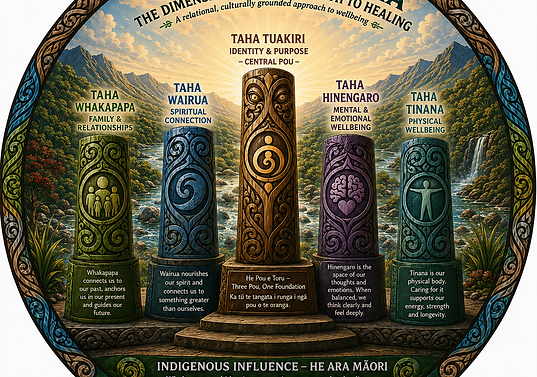
Examining the relevance and connection of Te Poutama o te Ora with Te Whare Tapa Whā (Durie, 1998). How do we apply modern concepts of Taha-Kai, Taha-Matihiko and Taha Pūtea, respecting the framework provided by Durie.
Podcasts - Indepth Academia.edu
In our latest paper, we introduce Te Whakahuatanga, the transformative phase of healing from Colonisation PTSD, emphasising the critical distinction between catharsis and metabolisation. By exploring the biological and psychological processes involved, we map the specific exiles faced by urban Māori and highlight the gifts that emerge when false identities are released. We invite you to read our work and share your thoughts!

In our latest paper, we explore the second phase of healing from Colonisation PTSD, emphasising the importance of somatic contact with wai-māori. We argue that true healing requires addressing the body's experiences and cultural memories, not just cognitive approaches. We invite you to read more about how this framework can inform clinical practices and foster deeper understanding in decolonisation work.

In our paper, we explore the Whakapapa Dilemma faced by Indigenous Christians, addressing not only exclusion from covenant narratives but also the anxiety stemming from genealogical purity. By examining a composite family photograph through a kaupapa Māori lens, we argue that Imago Dei is inherent to each person, allowing for a richer understanding of whakapapa as a theological resource rather than a barrier to faith. We invite you to read our work and share your thoughts!

We introduce the concept of normative abuse as a lens to understand how the impacts of colonisation have become so ingrained that they often go unrecognised as harm. By linking this idea to Colonisation PTSD, we aim to shed light on the mechanisms that perpetuate these experiences, offering insights for kaupapa Māori counselling practices and therapeutic approaches. We invite you to read our paper and share your thoughts!

In our latest paper, we introduce the healing arc of the Te Poutama Ora Framework, building on our previous work that proposed Colonisation PTSD as a clinical category. We explore the intergenerational impacts of colonisation and the dysfunction it creates, inviting you to engage with our findings and share your thoughts.

In our paper, we explore how everyday speech can perpetuate colonial trauma, using specific phrases as examples of clinically significant speech acts. We introduce the concept of Dimensional Autophagy as a way to metabolize these injuries, emphasizing the importance of understanding their intergenerational impact. We invite you to read our work and share your thoughts!

In our paper, we propose a fresh perspective on colonisation in Aotearoa New Zealand, viewing it not just as a historical event but as an ongoing trauma that affects generations through biological, psychological, and relational pathways. We invite you to explore how this framing can deepen our understanding of its contemporary impacts.

In our paper, we explore the Maramataka as the foundational temporal structure of Te Poutama Ora, a unique Māori wellness framework. We also introduce Te Ngāhau Kiri, a companion program designed to support deeper healing before participants embark on the nine-step wellness journey. We invite you to read more about this integration of traditional knowledge and contemporary wellness practices!

We introduce the Tinana Autophagy framework, the final piece of the Te Poutama Ora model, which emphasizes the body's role as an archive of our experiences and identities. By integrating the physical, relational, spiritual, and emotional dimensions, we explore how fasting and somatic release can lead to holistic healing within a Māori wellness context. We invite you to read our paper and share your thoughts!